Implementing a Customer Relationship Management (CRM) system in an electricity generation company is not just about managing contacts—it’s about optimizing operations, improving stakeholder communication, and enhancing data-driven decision-making. In a highly regulated and asset-intensive industry like energy, a well-configured CRM platform can significantly improve efficiency, reliability, and customer satisfaction. This guide explains how to successfully install and optimize a CRM system tailored to the needs of a power generation company.
Understanding the Role of CRM in the Energy Sector
Why CRM Matters in Electricity Generation
Unlike traditional businesses, electricity generation companies deal with a complex network of clients, regulators, suppliers, and internal teams. A CRM system helps centralize these interactions, ensuring transparency and better coordination. It enables companies to track contracts, manage service requests, and monitor communication history across departments.
Additionally, a CRM supports compliance management by maintaining accurate records required for audits and regulatory reporting. With increasing demand for sustainable energy solutions, companies also need tools to manage relationships with partners and communities, making CRM a critical asset.
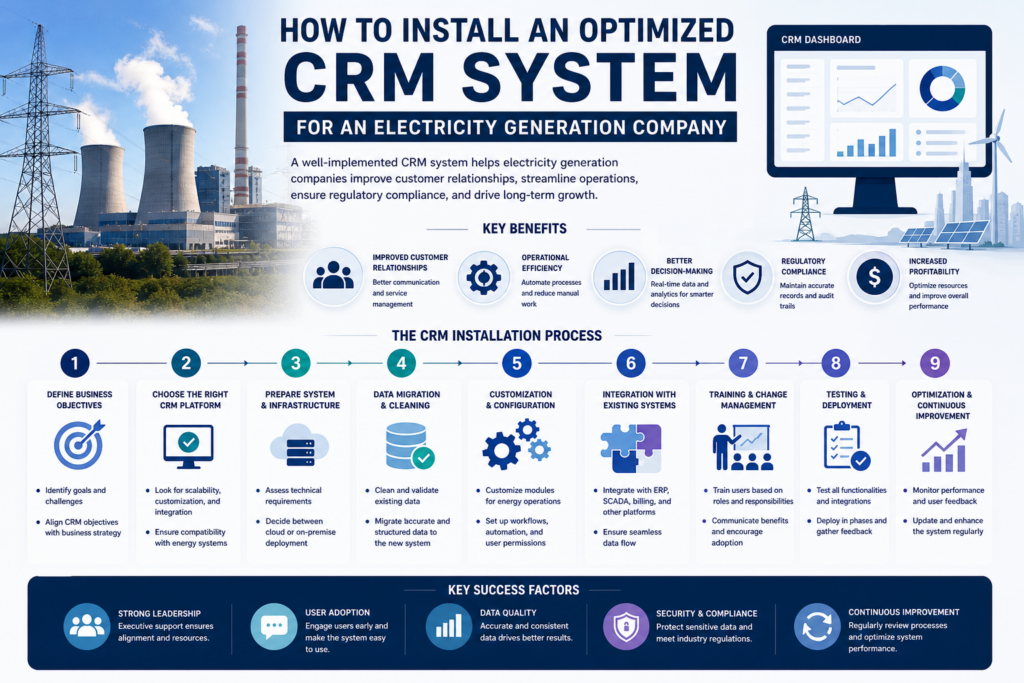
Planning Your CRM Implementation
Define Business Objectives
Before installing a CRM, clearly define your business goals. Are you aiming to improve customer service, streamline maintenance scheduling, or enhance sales processes for energy contracts? Establishing clear objectives ensures that the CRM is aligned with your company’s strategy.
Identify Key Stakeholders
Involve all relevant stakeholders, including operations teams, IT departments, sales managers, and executives. Their input is essential to ensure the CRM meets operational requirements and integrates smoothly into existing workflows.
Choose the Right CRM Platform
Select a CRM that supports scalability, customization, and integration capabilities. For electricity generation companies, it is crucial that the system can integrate with tools such as SCADA systems, ERP platforms, and energy management software.
System Preparation and Infrastructure Setup
Assess Technical Requirements
Evaluate your current IT infrastructure to determine whether you need a cloud-based or on-premise CRM. A cloud CRM offers flexibility and remote access, while an on-premise solution may provide greater control over sensitive data.
Data Migration Strategy
Prepare a detailed plan for data migration. This includes cleaning existing data, removing duplicates, and ensuring consistency. Migrating accurate and well-structured data is critical for the success of your CRM implementation.
Security and Compliance
Electricity companies handle sensitive information, making data security a top priority. Implement strong encryption, access controls, and compliance with industry regulations. Ensure the CRM meets standards for cybersecurity and data protection.
Customization and Configuration
Tailoring the CRM to Energy Operations
Customize the CRM to reflect the specific processes of your business. This may include modules for asset management, maintenance tracking, and energy contract management. A well-configured CRM should align with your operational workflows.
Workflow Automation
Set up automation rules to streamline repetitive tasks. For example, automate maintenance alerts, billing notifications, and customer follow-ups. Automation improves efficiency and reduces the risk of human error.
Integration with Existing Systems
Integrate the CRM with your existing systems, such as ERP, billing platforms, and monitoring tools. Seamless integration ensures that data flows smoothly across systems, providing a unified view of operations.
Training and Change Management
Employee Training
Provide comprehensive training for all users. Employees should understand how to use the CRM for their specific roles, whether in operations, sales, or customer service. Proper training ensures higher adoption rates and better results.
Change Management Strategy
Introducing a new CRM requires a structured change management approach. Communicate the benefits clearly and address any concerns from employees. Encourage adoption by demonstrating how the system simplifies their daily tasks.
Testing and Deployment
System Testing
Before full deployment, conduct thorough testing to identify and resolve any issues. Test all functionalities, including data accuracy, workflow automation, and system integrations.
Phased Deployment
Consider a phased rollout instead of launching the CRM across the entire organization at once. Start with a pilot group, gather feedback, and make necessary adjustments before expanding the implementation.
Optimization and Continuous Improvement
Performance Monitoring
After deployment, continuously monitor the performance of your CRM. Use analytics dashboards to track key metrics such as customer response times, maintenance efficiency, and sales performance.
Regular Updates and Enhancements
Keep the system updated with the latest features and improvements. Regular updates ensure that your CRM remains aligned with evolving business needs and technological advancements.
Feedback and Adaptation
Encourage feedback from users to identify areas for improvement. A successful CRM implementation is an ongoing process that evolves with your organization.
Benefits of an Optimized CRM for Electricity Companies
Improved Operational Efficiency
A well-implemented CRM streamlines processes, reduces manual work, and improves coordination between departments.
Enhanced Customer Relationships
With centralized data and better communication tools, companies can provide more personalized and responsive service to their clients.
Better Decision-Making
Access to real-time data and advanced analytics enables informed decision-making and strategic planning.
Regulatory Compliance
Maintaining accurate records and audit trails helps companies meet regulatory requirements more effectively.