In 2026, the auto insurance industry is more competitive and data-driven than ever before. Companies are constantly seeking ways to improve customer experience, optimize sales processes, and increase operational efficiency. One of the most powerful tools enabling this transformation is a modern Customer Relationship Management (CRM) system. For businesses that sell auto insurance, adopting a CRM is no longer optional—it is a strategic necessity that drives growth, retention, and profitability.
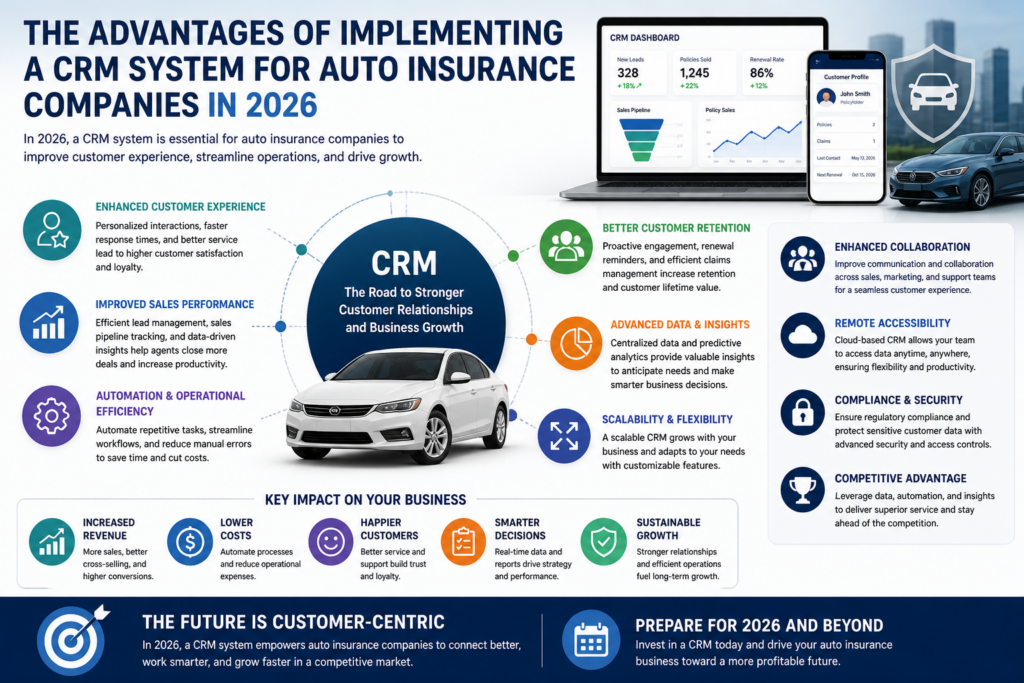
Enhanced Customer Experience
Personalized Interactions
A CRM system allows insurance companies to collect and analyze detailed customer data, including policy history, claims, preferences, and communication records. With this information, businesses can deliver highly personalized services, offering tailored policy recommendations and proactive support. Personalization not only improves customer satisfaction but also builds long-term trust and loyalty.
Faster Response Times
In the insurance sector, speed is critical. A CRM centralizes all customer information, enabling agents to respond quickly to inquiries, claims, and policy updates. This leads to improved response times and a more efficient customer support experience, which is essential in maintaining a competitive edge.
Improved Sales Performance
Efficient Lead Management
A CRM system streamlines lead management by capturing, organizing, and prioritizing potential customers. Sales teams can track leads through the entire sales pipeline, ensuring no opportunity is missed. Automated follow-ups and reminders help agents stay engaged with prospects and close deals faster.
Data-Driven Sales Strategies
With advanced analytics and reporting tools, companies can identify trends, measure performance, and refine their sales strategies. CRM dashboards provide insights into conversion rates, customer behavior, and revenue patterns, enabling smarter decision-making and more effective campaigns.
Automation and Operational Efficiency
Reducing Manual Work
Automation is one of the most significant benefits of a CRM system. Tasks such as sending emails, scheduling follow-ups, and updating records can be automated, reducing the need for manual input. This allows employees to focus on higher-value activities, such as building relationships and closing sales.
Streamlined Workflows
CRM systems enable the creation of customized workflows that align with business processes. From policy issuance to claims management, every step can be optimized for efficiency. This results in faster operations and fewer errors.
Better Customer Retention
Proactive Customer Engagement
Retaining customers is often more cost-effective than acquiring new ones. A CRM helps companies maintain regular communication with clients through automated reminders, renewal notifications, and personalized offers. This proactive approach increases customer retention and reduces churn.
Improved Claims Management
Handling claims efficiently is crucial in the insurance industry. A CRM system provides a centralized platform to track and manage claims, ensuring transparency and faster resolution. Satisfied customers are more likely to renew their policies and recommend the company to others.
Advanced Data Management and Insights
Centralized Data System
A CRM acts as a single source of truth for all customer information. This eliminates data silos and ensures that all departments have access to accurate and up-to-date information. Centralized data improves collaboration and decision-making across the organization.
Predictive Analytics
Modern CRM systems in 2026 leverage artificial intelligence and predictive analytics to anticipate customer needs and behaviors. For example, insurers can identify customers who are likely to renew or those at risk of leaving, allowing them to take proactive measures.
Scalability and Flexibility
Adapting to Business Growth
As an auto insurance company grows, managing a larger customer base becomes more complex. A scalable CRM system can handle increasing volumes of data and users without compromising performance. This ensures that the system remains effective as the business expands.
Customizable Features
CRM platforms offer flexible configurations that allow businesses to tailor the system to their specific needs. Whether it’s customizing dashboards, workflows, or reporting tools, companies can adapt the CRM to align with their unique processes.
Enhanced Collaboration
Improved Team Communication
A CRM system facilitates better team collaboration by providing shared access to customer data and communication history. Sales, marketing, and support teams can work together more effectively, ensuring a consistent customer experience.
Remote Accessibility
In 2026, remote work and mobile access are essential. Cloud-based CRM systems allow employees to access data from anywhere, enabling flexibility and continuous productivity.
Regulatory Compliance and Security
Meeting Industry Regulations
The insurance industry is heavily regulated, requiring strict compliance with data protection laws. A CRM system helps companies maintain accurate records and ensure compliance with regulations, reducing the risk of penalties.
Data Security
Protecting sensitive customer information is critical. Modern CRM systems use advanced encryption and security protocols to safeguard data, ensuring trust and reliability.
Competitive Advantage in 2026
Staying Ahead of the Competition
Companies that adopt CRM technology gain a significant competitive advantage. By leveraging data, automation, and analytics, they can offer better services, respond faster, and operate more efficiently than competitors who rely on outdated systems.
Innovation and Growth
A CRM system supports continuous innovation by providing insights and tools that enable businesses to adapt to changing market conditions. This ensures long-term growth and sustainability.
Conclusion
In 2026, implementing a CRM system is a transformative step for auto insurance companies. From enhancing customer experience and improving sales performance to increasing operational efficiency and ensuring regulatory compliance, the benefits are substantial. By investing in a modern CRM, insurance businesses can streamline their operations, strengthen customer relationships, and position themselves for long-term success in an increasingly competitive market.