In today’s competitive business environment, companies are increasingly investing in Customer Relationship Management (CRM) systems to improve customer service, increase sales, and automate business operations. Whether it is a small startup or a large corporation, implementing a CRM platform can transform the way a company manages relationships with customers and clients.
However, one of the most common questions businesses ask is: How much does it cost to install a CRM system, and what does the implementation process involve?
The answer depends on several factors, including the size of the company, the complexity of the system, the number of users, customization requirements, and the chosen CRM platform.
What Is a CRM System?
A CRM system is software designed to help businesses manage:
- Customer information
- Sales processes
- Marketing campaigns
- Customer support
- Business analytics
Popular CRM platforms include:
- Salesforce
- HubSpot
- Microsoft Dynamics 365
- Zoho CRM
- Pipedrive
These platforms allow businesses to centralize customer data and improve operational efficiency.
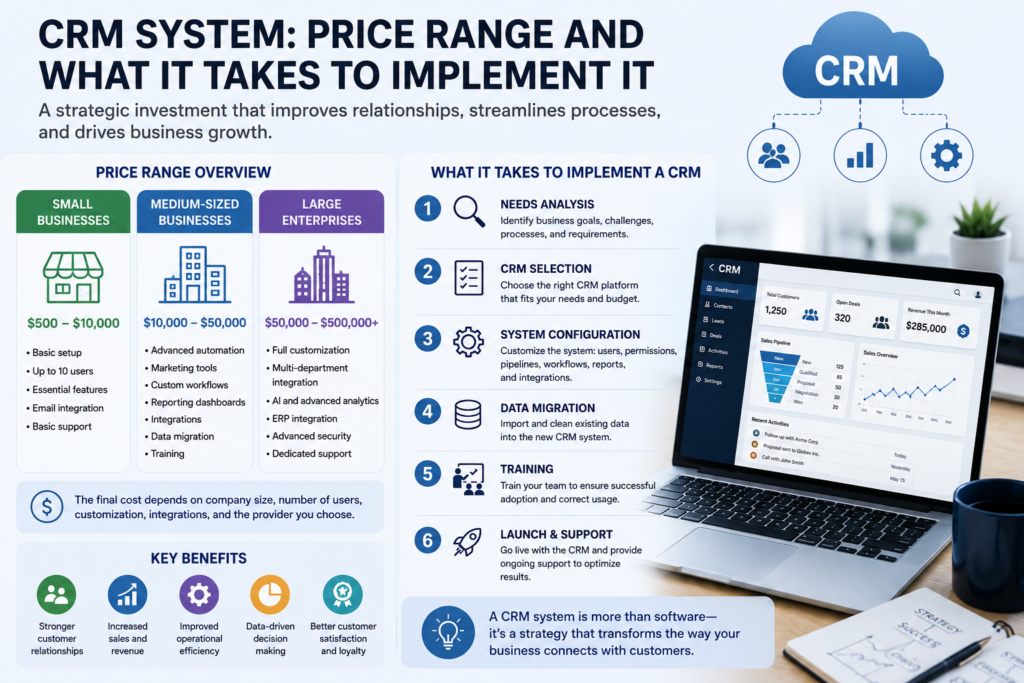
Average CRM Installation Price Range
The cost of implementing a CRM system can vary greatly depending on the company’s needs.
1. Small Businesses
Estimated Cost: $500 – $10,000
Small companies often choose cloud-based CRM solutions with fewer users and simpler configurations.
What Is Included
- Basic CRM setup
- User accounts
- Email integration
- Sales tracking
- Basic customer support
Small businesses usually use subscription-based services that charge monthly fees per user.
2. Medium-Sized Businesses
Estimated Cost: $10,000 – $50,000
Mid-sized companies often require:
- Advanced automation
- Marketing tools
- Reporting dashboards
- Third-party integrations
Additional Costs
- Employee training
- Data migration
- Workflow customization
- API integrations
At this level, implementation becomes more technical and may require external consultants.
3. Large Enterprises
Estimated Cost: $50,000 – $500,000+
Large organizations typically require highly customized CRM environments.
Enterprise CRM Features
- AI-powered analytics
- Multi-department integration
- ERP connectivity
- Advanced cybersecurity
- Global customer databases
Enterprise CRM implementations often involve teams of developers, consultants, and project managers.
Main Factors That Affect CRM Costs
1. CRM Software License Fees
Most CRM providers charge:
- Monthly subscriptions
- Annual contracts
- Per-user licensing fees
For example:
- Basic plans may cost $15–$50 per user/month
- Advanced enterprise plans can exceed $300 per user/month
2. Customization
Many companies need CRM systems tailored to their business processes.
Customization may include:
- Custom dashboards
- Automated workflows
- Industry-specific modules
- Personalized reports
The more customization required, the higher the implementation cost.
3. Data Migration
Companies migrating from spreadsheets or old software must transfer:
- Customer records
- Sales histories
- Contact databases
- Marketing data
Data migration can be complex and time-consuming, especially for large organizations.
4. Employee Training
Training is one of the most important parts of CRM implementation.
Employees must learn:
- How to use the system
- How to manage customer data
- How to automate tasks
- How to generate reports
Without proper training, companies may struggle to fully adopt the system.
5. Integration with Other Software
CRM systems often need to connect with:
- Accounting software
- ERP systems
- Email marketing platforms
- E-commerce websites
- Inventory management systems
These integrations may require technical development and increase costs.
What Is Involved in Installing a CRM System?
1. Business Analysis
Before installation, companies must identify:
- Their goals
- Business challenges
- Customer management needs
This phase helps determine which CRM platform is most suitable.
2. System Selection
Businesses choose a CRM based on:
- Company size
- Budget
- Required features
- Industry needs
Some companies prefer cloud-based CRM systems, while others choose on-premise installations.
3. CRM Configuration
After selecting the platform, the system must be configured.
This includes:
- User permissions
- Sales pipelines
- Contact forms
- Automated workflows
- Reporting dashboards
4. Data Import and Migration
Existing customer data is cleaned, organized, and transferred into the new CRM platform.
This process is critical because inaccurate data can create operational problems.
5. Testing and Optimization
Before launching the CRM system company-wide, businesses usually perform:
- Functionality testing
- Security testing
- Workflow validation
Adjustments are made to improve performance and usability.
6. Employee Training and Launch
Once the CRM is ready:
- Employees receive training
- Teams begin using the platform
- Managers monitor adoption and productivity
Successful implementation requires ongoing support and updates.
Benefits of Installing a CRM System
Despite the costs, CRM systems provide major long-term benefits.
1. Improved Customer Relationships
CRM platforms help businesses understand customer behavior and provide personalized experiences.
2. Increased Sales
Sales teams can better track leads, opportunities, and customer interactions.
3. Better Productivity
Automation reduces repetitive tasks and improves workflow efficiency.
4. Data-Driven Decisions
CRM analytics help managers make smarter business decisions using real-time information.
Common Challenges During CRM Implementation
Some companies face difficulties such as:
- Employee resistance to change
- Poor data quality
- Budget overruns
- Lack of technical expertise
Proper planning and training are essential to avoid these issues.
Cloud CRM vs On-Premise CRM
Cloud CRM
- Lower initial costs
- Easier updates
- Remote access
- Subscription-based pricing
On-Premise CRM
- Greater control over data
- Higher upfront investment
- Requires internal IT management
Most modern businesses prefer cloud-based CRM solutions due to flexibility and scalability.
Conclusion
Installing a CRM system is a strategic investment that can significantly improve a company’s operations, customer relationships, and sales performance. While costs can range from a few hundred dollars to hundreds of thousands depending on company size and complexity, the long-term benefits often justify the investment.
Successful CRM implementation involves much more than simply purchasing software. It requires planning, customization, data migration, employee training, and ongoing optimization. Companies that invest in the right CRM strategy can gain a strong competitive advantage in today’s digital business environment.