In today’s business world, CRM systems are essential tools for companies that want to improve customer service, increase sales, and build long-term relationships with clients. From small startups to global corporations, businesses rely on Customer Relationship Management (CRM) software to organize customer data, automate communication, and analyze customer behavior. But many people still ask an important question: who actually invented the CRM system?
The answer is not as simple as naming one single inventor. The modern CRM industry evolved through decades of technological innovation, database management, and sales automation. Several companies and pioneers contributed to the development of what we now know as CRM software. Understanding the history of CRM helps explain why it became one of the most valuable technologies in modern business.
The Meaning of CRM
Before exploring its origins, it is important to understand what CRM actually means.
Customer Relationship Management refers to strategies, technologies, and systems that businesses use to manage interactions with customers. A CRM platform stores customer information such as contact details, purchase history, communication records, and service requests. It allows businesses to create stronger customer relationships while improving efficiency and profitability.
Modern CRM systems often include:
- Sales automation
- Marketing tools
- Customer support management
- Data analytics
- Email integration
- Artificial intelligence
- Cloud-based services
However, CRM did not begin with sophisticated software. Its roots go back to much simpler systems.
The Early Foundations of CRM
Rolodex and Manual Customer Tracking
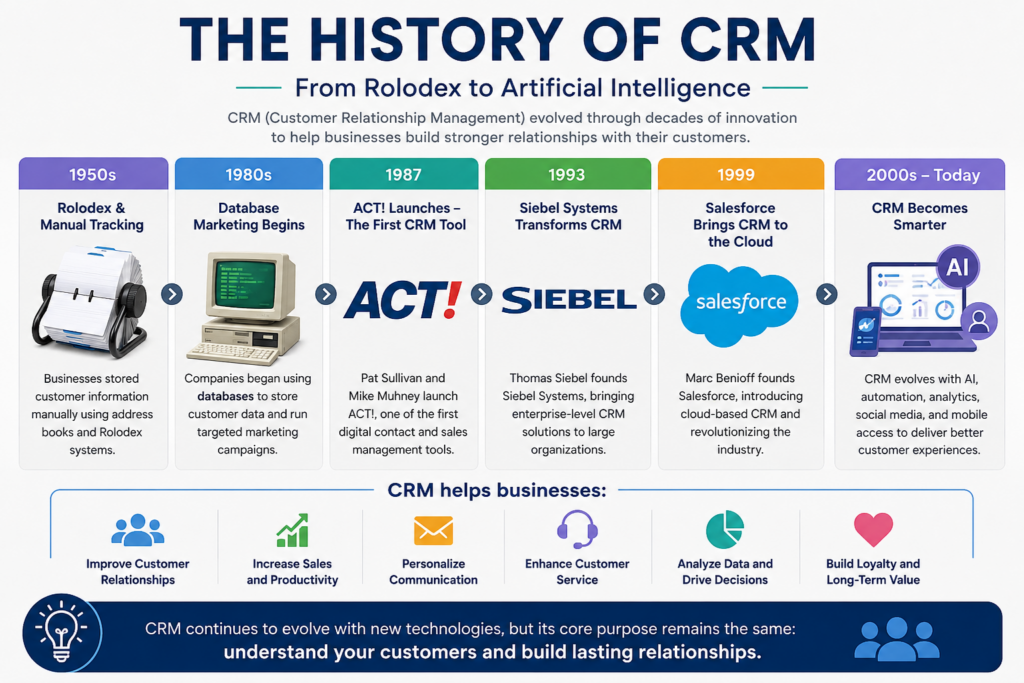
Long before computers existed, businesses tracked customer information manually. Salespeople kept notebooks, paper files, and address books containing customer details. One of the earliest tools associated with customer management was the Rolodex, invented in the 1950s.
The Rolodex allowed businesses to organize contact information efficiently. Although it was entirely physical, it represented an early form of customer relationship management because it focused on maintaining organized customer records.
At this stage, customer management was highly personal. Sales representatives depended on memory, handwritten notes, and direct relationships with clients.
The Rise of Database Marketing in the 1980s
The real foundation of modern CRM began during the 1980s with the rise of database marketing.
Businesses started using computers to store customer information digitally. Instead of relying only on paper records, companies created electronic databases that tracked customer purchases and preferences.
Robert and Kate Kestnbaum
Many historians credit Robert and Kate Kestnbaum as pioneers of database marketing. They helped businesses use statistical methods and customer data to improve marketing campaigns. Their work laid important groundwork for CRM because it introduced the idea that customer information could be analyzed strategically.
During this period, companies realized that customer data had enormous value. Businesses could now segment audiences, predict buying behavior, and personalize marketing efforts.
This transformation moved customer management from simple record keeping into a data-driven business strategy.
The Birth of Sales Automation
Pat Sullivan and ACT!
One of the most important milestones in CRM history came in 1987 when Pat Sullivan and Mike Muhney developed ACT!, one of the first digital contact management software programs.
ACT! allowed salespeople to store customer contacts, schedule meetings, track conversations, and manage sales activities electronically. It replaced traditional paper-based systems with a computer-based solution.
Many experts consider ACT! to be one of the earliest true CRM products because it focused specifically on improving customer interactions and sales organization.
The software quickly became popular among sales professionals because it increased productivity and simplified customer management.
Why ACT! Was Revolutionary
ACT! introduced several innovations that later became standard CRM features:
- Centralized customer databases
- Appointment scheduling
- Task management
- Sales tracking
- Contact history
Although basic by today’s standards, ACT! represented a major breakthrough in business software.
The Emergence of Siebel Systems
Thomas Siebel and Modern CRM
If one individual is most closely associated with inventing the modern CRM industry, it is probably Thomas Siebel.
In 1993, Siebel founded Siebel Systems, a company that became one of the world’s leading CRM software providers during the 1990s.
Siebel Systems expanded CRM beyond simple contact management. The company developed enterprise-level software that integrated:
- Sales management
- Marketing automation
- Customer service
- Technical support
- Data reporting
Thomas Siebel recognized that businesses needed a unified system capable of managing every stage of the customer journey.
Why Siebel Systems Changed the Industry
Siebel Systems transformed CRM into a major corporate technology category. Large companies adopted the platform to improve customer communication and operational efficiency.
The software became especially important for industries such as:
- Banking
- Telecommunications
- Healthcare
- Manufacturing
- Retail
By the late 1990s, Siebel Systems dominated the CRM market and helped establish CRM as a core business strategy.
For this reason, many people refer to Thomas Siebel as the “father of modern CRM.”
The Internet Revolution and Cloud CRM
Salesforce and Marc Benioff
Another major turning point occurred in 1999 when Marc Benioff founded Salesforce.
Unlike earlier CRM software that required expensive installations on company servers, Salesforce introduced a cloud-based CRM model. Businesses could access CRM tools through the internet without maintaining complex hardware systems.
This innovation changed the software industry forever.
The Impact of Cloud Computing
Cloud CRM offered several advantages:
- Lower costs
- Easier updates
- Remote access
- Faster implementation
- Better scalability
Salesforce popularized the concept of Software as a Service (SaaS), which later became standard across the technology industry.
Today, most CRM systems operate through cloud platforms because they are more flexible and accessible than traditional software installations.
How CRM Evolved Over Time
CRM technology continued evolving rapidly during the 2000s and 2010s.
Integration with Marketing and Social Media
Modern CRM platforms expanded far beyond sales tracking. Companies started integrating:
- Social media monitoring
- Email marketing
- Customer analytics
- Mobile applications
- Artificial intelligence
CRM systems became comprehensive business ecosystems capable of managing nearly every customer interaction.
Artificial Intelligence and Automation
Today’s CRM platforms use AI-powered tools to analyze customer behavior, predict sales opportunities, and automate repetitive tasks.
Features now include:
- Chatbots
- Predictive analytics
- Automated workflows
- Personalized recommendations
- Real-time customer insights
Artificial intelligence has transformed CRM into a highly intelligent business solution rather than a simple database.
Who Truly Invented CRM?
The invention of CRM cannot be credited to one single person because the technology evolved gradually over decades.
However, several figures played crucial roles:
Important CRM Pioneers
Robert and Kate Kestnbaum
They pioneered database marketing and customer data analysis.
Pat Sullivan
Co-created ACT!, one of the first digital sales management systems.
Thomas Siebel
Built the first major enterprise CRM platform and popularized CRM as a business category.
Marc Benioff
Revolutionized CRM through cloud computing with Salesforce.
Each contributed different innovations that shaped the modern CRM industry.
Why CRM Became So Important
Businesses adopted CRM systems because customer relationships became increasingly valuable in competitive markets.
Benefits of CRM Systems
Modern CRM platforms help companies:
- Improve customer satisfaction
- Increase sales performance
- Personalize communication
- Automate repetitive tasks
- Analyze customer behavior
- Strengthen long-term relationships
CRM systems also help organizations make smarter decisions using customer data and analytics.
The Shift Toward Customer-Centric Business
In the past, companies focused mainly on products. Today, businesses focus heavily on customer experience.
CRM software supports this transformation by helping organizations understand customer needs more effectively.
As competition increases globally, customer loyalty has become one of the most important factors for business success.
The Future of CRM
The CRM industry continues evolving rapidly.
AI-Driven CRM
Artificial intelligence is expected to play an even bigger role in CRM systems. Future platforms may offer:
- Advanced predictive analytics
- Fully automated customer support
- Voice-controlled CRM assistants
- Hyper-personalized marketing
- Emotional sentiment analysis
AI will likely make CRM systems smarter, faster, and more efficient.
Mobile and Remote Accessibility
As remote work becomes more common, CRM systems are increasingly designed for mobile devices and cloud collaboration.
Businesses now expect employees to access customer information anytime and anywhere.
CRM and Big Data
The integration of Big Data with CRM platforms allows companies to process massive amounts of customer information in real time.
This helps organizations better predict trends and deliver highly personalized experiences.
Conclusion
The invention of the CRM system was not the achievement of a single individual but the result of decades of innovation in customer management, database technology, and business software.
Early tools like the Rolodex introduced organized customer tracking, while pioneers such as Robert and Kate Kestnbaum advanced database marketing. Later, Pat Sullivan helped digitize sales management through ACT!, and Thomas Siebel transformed CRM into a global enterprise technology. Finally, Marc Benioff revolutionized the industry with cloud-based CRM through Salesforce.
Today, CRM systems are among the most important technologies in modern business. They help companies improve customer relationships, increase efficiency, and drive long-term growth.
As technology continues evolving through artificial intelligence, cloud computing, and Big Data, CRM systems will likely become even more powerful in the future. What began as simple customer record keeping has evolved into one of the most influential business technologies in the world.