In today’s business world, Customer Relationship Management (CRM) systems are considered essential tools for companies of all sizes. They help organizations manage customer interactions, improve sales processes, analyze data, and strengthen long-term relationships with clients. However, the creation of CRM systems did not happen overnight. The development of CRM technology was the result of decades of changes in business strategies, customer expectations, and technological innovation. Understanding how CRM systems emerged provides valuable insight into how businesses evolved from simple customer recordkeeping to highly sophisticated digital ecosystems.
The Early Importance of Customer Relationships
Long before computers existed, merchants understood the value of maintaining strong relationships with their customers. In small communities, shop owners knew their buyers personally, remembered their preferences, and offered personalized services. This approach created customer loyalty and encouraged repeat business.
As industries expanded during the Industrial Revolution, businesses began serving larger populations. Companies could no longer rely solely on personal memory to track customer information. The growing scale of commerce created the need for organized methods to store customer details, purchase histories, and communication records.
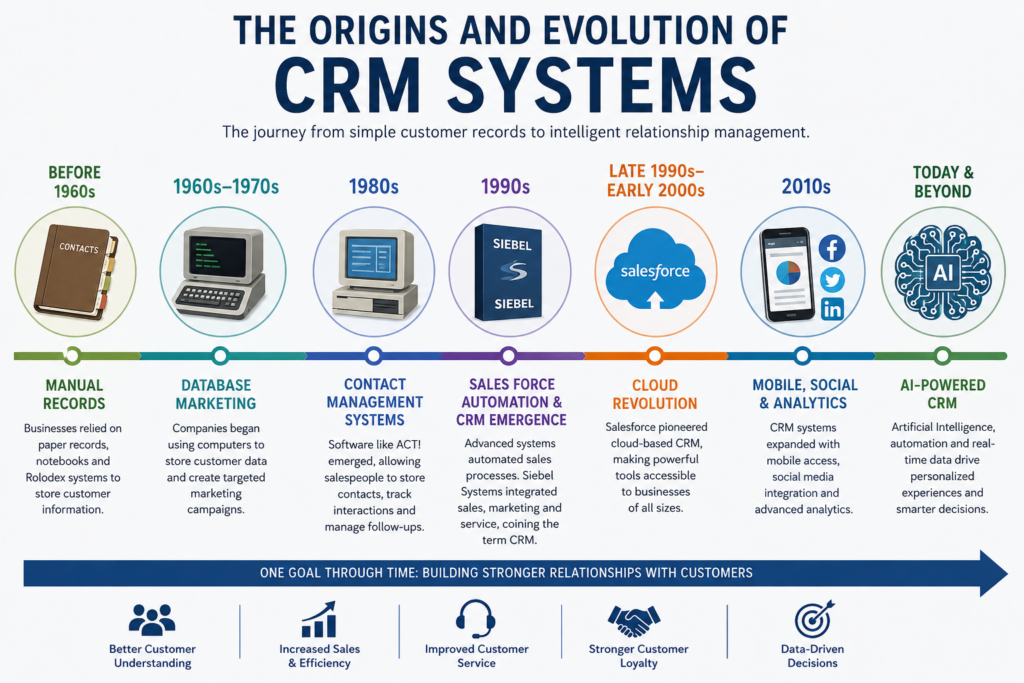
During the late nineteenth and early twentieth centuries, businesses started using physical tools such as notebooks, filing cabinets, and Rolodex systems to organize customer information. Although these methods were simple, they represented the earliest forms of customer relationship management.
The Rise of Database Marketing
The foundation of modern CRM systems began to take shape during the 1960s and 1970s with the emergence of database marketing. Companies started collecting customer information in digital databases instead of paper records. Advances in computer technology allowed organizations to store larger amounts of data and retrieve information more efficiently.
Database marketing focused on gathering customer demographics, buying habits, and transaction histories. Businesses used this information to create targeted marketing campaigns and improve communication with customers. This represented a major shift from mass marketing toward personalized marketing strategies.
Large corporations, especially in banking, telecommunications, and retail, quickly realized the competitive advantages of customer data analysis. By understanding consumer behavior, companies could increase sales and build stronger customer loyalty.
The Influence of Mainframe Computers
The introduction of mainframe computers played a critical role in the evolution of CRM concepts. These large systems enabled businesses to process vast amounts of customer data faster than ever before. Although expensive and accessible only to major organizations, mainframes demonstrated the potential of technology-driven customer management.
At this stage, customer information systems were still limited. They mainly focused on sales records and mailing lists rather than complete customer interaction management. Nevertheless, they laid the groundwork for future CRM innovations.
Contact Management Systems in the 1980s
During the 1980s, businesses experienced rapid growth in personal computing. The arrival of desktop computers transformed how organizations managed information. This decade marked the birth of contact management systems, which many experts consider the direct ancestors of modern CRM software.
Contact management applications allowed sales teams to store customer names, phone numbers, addresses, and notes digitally. Sales representatives could organize appointments, track conversations, and manage follow-ups more effectively.
One of the most influential developments during this period was the creation of ACT!, launched in 1987 by Pat Sullivan and Mike Muhney. ACT! became one of the first widely used software solutions designed specifically to help sales professionals manage customer interactions.
The success of contact management software proved that businesses were ready to adopt digital tools to improve customer relationships. However, these early systems still focused mainly on sales activities rather than comprehensive customer management.
## The Emergence of Sales Force Automation
In the late 1980s and early 1990s, companies began developing more advanced technologies known as Sales Force Automation (SFA) systems. These platforms expanded beyond contact management by automating sales tasks such as opportunity tracking, forecasting, and pipeline management.
Sales Force Automation improved efficiency by reducing manual administrative work. Sales representatives could spend more time interacting with customers and less time organizing paperwork.
This period also saw increased competition among software companies seeking to dominate the growing market for customer management tools. Businesses recognized that customer information was becoming one of their most valuable assets.
The Role of Siebel Systems
A major milestone in CRM history occurred in 1993 with the founding of Siebel Systems by Thomas Siebel. The company introduced enterprise-level customer management software designed for large organizations.
Siebel Systems became highly successful because its software integrated sales, marketing, and customer service functions into a single platform. This integration represented a revolutionary step forward in business technology.
For the first time, companies could centralize customer data across multiple departments. Employees gained access to consistent information, which improved communication and customer satisfaction.
By the mid-1990s, the term Customer Relationship Management officially emerged to describe these integrated systems.
The Internet Revolution and CRM Expansion
The rise of the Internet during the 1990s dramatically accelerated CRM development. Businesses now had new ways to communicate with customers through email, websites, and online support systems.
Internet technology allowed CRM software to become more interactive and accessible. Companies could collect real-time customer information, monitor online behavior, and provide faster support services.
The Internet also transformed customer expectations. Consumers began demanding personalized experiences, faster responses, and better service quality. Businesses needed advanced systems capable of managing growing volumes of digital interactions.
CRM platforms evolved to include marketing automation, customer service management, analytics, and reporting tools. These improvements made CRM systems essential for maintaining competitiveness in the digital economy.
The Shift Toward Cloud Computing
One of the most significant transformations in CRM history occurred with the introduction of cloud computing in the late 1990s and early 2000s.
Traditionally, CRM software required expensive on-site servers and complex installations. Small businesses often could not afford these systems. Cloud technology changed this model by allowing companies to access CRM platforms through the Internet.
In 1999, Salesforce was founded by Marc Benioff. Salesforce pioneered the concept of cloud-based CRM, offering software as a service (SaaS). Instead of purchasing expensive software licenses, businesses could subscribe to CRM services online.
This innovation revolutionized the CRM industry. Cloud-based systems reduced costs, simplified updates, and increased accessibility. Companies of all sizes could now benefit from advanced CRM tools.
Salesforce quickly became one of the most influential companies in the CRM market and inspired many competitors to adopt cloud technology.
The Integration of Artificial Intelligence
As technology advanced during the 2010s, CRM systems became increasingly sophisticated through the integration of Artificial Intelligence (AI) and Big Data analytics.
Modern CRM platforms can analyze customer behavior, predict purchasing trends, automate communication, and personalize marketing campaigns. AI-powered chatbots provide customer support twenty-four hours a day, while predictive analytics help businesses make data-driven decisions.
CRM systems also became integrated with social media platforms, enabling organizations to monitor customer opinions and engage directly with audiences online.
The use of mobile technology further expanded CRM accessibility. Sales teams can now access customer information from smartphones and tablets anywhere in the world.
CRM as a Strategic Business Tool
Today, CRM is no longer limited to customer data storage. It has become a strategic tool that influences nearly every aspect of business operations.
Modern CRM systems support sales management, marketing automation, customer service, project management, and even employee collaboration. Companies use CRM platforms to improve efficiency, increase revenue, and strengthen customer loyalty.
The importance of CRM continues to grow because businesses operate in highly competitive markets where customer experience plays a critical role in success.
The Future of CRM Systems
The future of CRM systems will likely involve even greater integration of Artificial Intelligence, machine learning, automation, and predictive analytics. Businesses are expected to rely increasingly on personalized customer experiences driven by real-time data analysis.
Emerging technologies such as voice assistants, augmented reality, and advanced automation may redefine how companies interact with customers in the coming years.
Additionally, concerns about data privacy and cybersecurity will shape future CRM development. Companies must balance personalization with ethical data management practices.
Despite these challenges, the fundamental goal of CRM remains unchanged: building strong and lasting relationships with customers.
The creation of CRM systems was the result of a long evolution in business practices and technological innovation. From handwritten customer records to advanced AI-powered platforms, CRM has transformed how companies interact with their customers.
The journey began with simple relationship-building techniques used by local merchants and evolved through database marketing, contact management software, Sales Force Automation, and cloud computing innovations. Companies such as ACT!, Siebel Systems, and Salesforce played crucial roles in shaping the CRM industry into what it is today.
Modern CRM systems are far more than digital address books. They are comprehensive platforms that help businesses understand customer behavior, improve communication, and drive long-term growth.
As technology continues to evolve, CRM systems will remain central to business strategy, helping organizations adapt to changing customer expectations and increasingly competitive global markets.